

What Was The Service Rifle In Korean War
Form follows part
A Brief Look at U.Southward. Regular army Standard Service Rifles and Team Automatic Weapons since WWII
Abstract The Army'south option of a standardized caliber bullet has always determined the option of its burglarize and team automatic weapon. Weight, charge per unit of burn down, lethality and bullet standardization are constant factors that guide the Army in adoption of new weapons systems.
Since the beginning of modern warfare, the evolution of a cartridge that provided required maximum effective range and accurateness, penetration, and lethality, have dictated burglarize and automatic weapons pattern. Form (rifle) follows function (cartridge desired). The development of a modern cartridge that was mutually uniform for a Team Automatic Weapon (SAW), became the backbone of modern Infantry doctrine. A dependable SAW with a high rate of accurate long-range burn suppressed enemy concentrations and enabled the remainder of the rifle squad to maneuver. Ammunition compatibility with all infantry squad weapons was desired from a logistics standpoint considering information technology meant 1 cartridge fits all. Ammunition redistribution during and after a firefight was simpler and more efficient.
-
Chief article
- Page 1
-
-
Sidebar
- Takeaways
-
-
Endnotes
- Show all Hide all
- Endnotes folio
-
- Download print version (PDF)
- v.56x45mm NATO
- 6.5mm Creedmore
- 7.62x51mm NATO
- .30-06
The Regular army adopted its starting time mod infantry rifle in 1903, the M1903 Springfield, chambered in .30-06. The .thirty-06 Springfield cartridge reflected advances in ballistics and aerodynamics fabricated past European militaries. At the time the .30-06 was adopted, ammunition weight was non a major factor considering long range accuracy and lethality were the most important factors. The Springfield proved to be a reliable, accurate, and hard-hitting weapon in First World War trench warfare. However, as World War II loomed on the horizon, a bolt-activity burglarize with an internal five-bullet magazine was not sufficient to back up infantry team maneuver tactics based on the support capabilities of the M1918 Browning Automated Weapon (BAR), the standard infantry squad automatic weapon.
1 "The M1 Garand Rifle," encounter "The Springfield .xxx-06 Cartridge," on internet at https://m1-garand-rifle.com/30-06/ , accessed iv June 2019.
Developed in 1917 and chambered in .thirty-06, the BAR proved devastating in the trench fighting of Globe War I. It was employed by the Army during Earth War Two, the Korean State of war, and was used by ethnic forces in Vietnam. An exceptionally rugged and dependable weapon, the major shortcoming of the BAR was its weight (virtually 20lbs) and heavy twenty-cartridge magazine. The squad had to carry actress .xxx-06 ammunition for the BAR gunner, which reduced the individual rifleman's basic load.
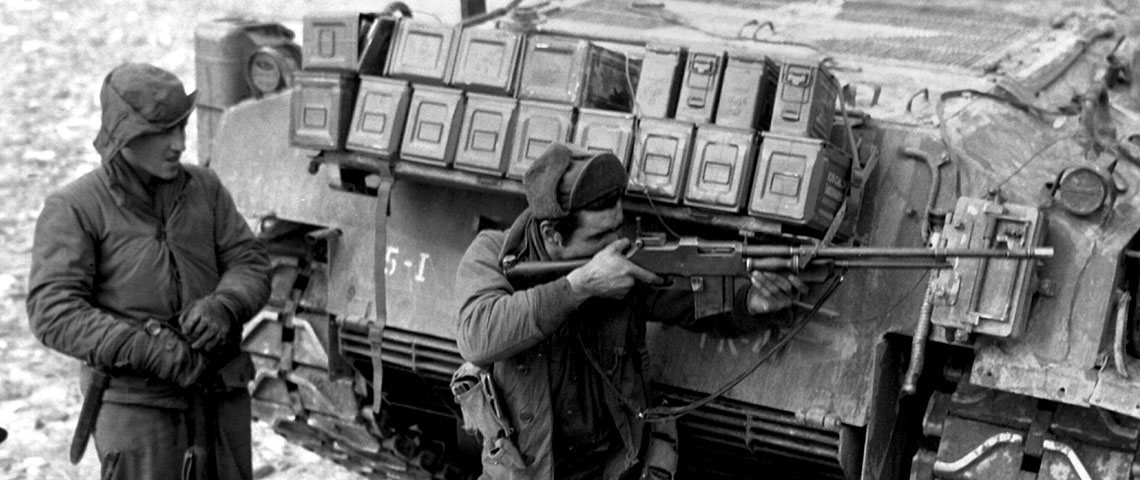
To increase firepower in the infantry team, in 1936 the Army adopted the M-1 Garand rifle. Chambered in .30-06, it shared the same ammunition as the BAR. Considered ane of the best rifles of WWII, it was unusual considering it was semi-automatic with an internal eight- cartridge magazine. Information technology gave an American infantry squad greater firepower than the Germans, Italians, or Japanese, who, through 1944, were primarily armed with bolt action rifles. Because of advances in firearms engineering following the Korean State of war, the Regular army wanted a lighter standard service rifle with selective-fire.
2 National Park Service, "M1 "Garand," U.Southward. Rifle quotient .30," on net at https://www.nps.gov/stri/upload/M1-Garand-Rifle-Manual_2018.pdf , accessed iv June 2019.
Standard Service Rifles
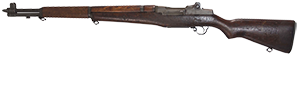
Yard-1 Garand
In service: 1936-1959
Caliber: .30-06
Capacity: 8 rounds

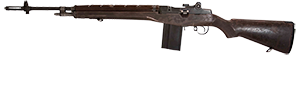
M-14
In service: 1959-still in express employ
Caliber: 7.62mm
Capacity: 20 rounds

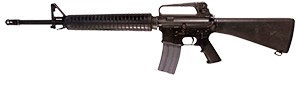
K-16
In service: 1964-present
Quotient: v.56mm
Chapters: xxx rounds

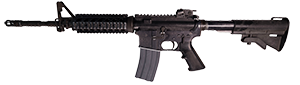
M4A1
In service: 1994-present
Caliber: five.56mm
Capacity: 30 rounds
Weight comparison in pounds
Range comparison in meters
As America moved deeper into the Cold War, it needed to adopt a new standardized cartridge. A full-sized .30-06 cartridge put too much strain on a redesigned rifle mechanism. In 1954 the Army adopted the smaller and lighter 7.62x51mm NATO cartridge. The bullet, with ballistic characteristics similar to the .30-06, was adopted as standard by the North Atlantic Treaty Organization (NATO). Equally opposed to the .xxx-06 of WWII, this new NATO cartridge allowed interoperability with centrolineal forces.
To use the seven.62x51mm NATO cartridge, the Regular army beginning modified the M-i bedchamber and barrel to burn the 7.62x51mm NATO cartridge so designed the Thousand-14 burglarize in 1957 around that new standard cartridge. The M-fourteen replaced the M-1 as the standard service rifle and the BAR equally the squad automatic weapon. While a reliable weapon, in practice the M-14 could not replace such a broad array of weaponry. The One thousand-14 was a pound lighter and had a greater cartridge capacity (20) than the M-1, allowing soldiers to behave more cartridges and have greater firepower. The drawbacks were that its forest stock and length was not suited to the jungle surround of Vietnam, a conflict the U.S. Army became embroiled in after the adoption of the weapon. Although only used every bit the Army's standard service burglarize for a short fourth dimension (1957-1967) before it was replaced by the M-16 family of rifles, the accurate M-14 remains in limited service for special roles.
three Bruce F. Kay, "An Analysis of the Infantry's Need for an Assault Submachine Gun," (Primary of Military Art and Scientific discipline Thesis, U.Due south. Army Command and General Staff College, 1977), viii., on cyberspace at https://apps.dtic.mil/dtic/tr/fulltext/u2/a044796.pdf , accessed 5 June 2019
The Army continued to use the 7.62x51mm NATO cartridge in the M-60 automobile gun, conceived to take over the part of the M1919 medium machine gun. However, while information technology also displaced the BAR, the G-60 proved inadequate as a squad automatic weapon. It was and so heavy that soldiers affectionately referred to it every bit 'the pig.' Information technology besides fired unlike armament (7.62x51mm NATO) than the M-16 (5.56x45mm NATO), the rifle that replaced the Chiliad-14, requiring squad members to comport additional, heavy, not-compatible ammunition to 'feed' the G-60.
four K threescore 7.62mm Machine Gun, Global Security.org, on internet at https://www.globalsecurity.org/military/systems/ground/m60mg-history.htm , accessed vi June 2019. The M-60 was originally conceived to take over the office of the M1919A6 Browning medium auto gun.
5 Chris Eger, "The M60 Machine Gun: It's the 'Pig Man'!," Guns.com, 29 May 2013, on net at https://www.guns.com/news/2013/05/29/the-m60-car-gun-and-they-called-information technology-the-pig , accessed 26 June 2019.
The AR-15 rifle, after adopted in modified class as the Thousand-16, fully replaced the M-14 by 1969. The lighter selective-fire rifle fired a .223 Remington cartridge that evolved into the v.56x45mm NATO cartridge in the 1980s. The cartridge was much lighter than the 7.62x51mm NATO cartridge, assuasive each soldier to acquit more armament. In add-on, the recoil was less, reducing user fatigue and increasing the probability of 2d and tertiary hits. The M-16, unlike the M-fourteen, could also be fired controllably and accurately on automatic, an important consideration as the majority of the adversaries were armed with the selective-fire Soviet/Warsaw Pact/Chinese AK-47. The M-16, including its current variant, the One thousand-4A1, has been the main U.S. Army service rifle for fifty years.
6 Michael Shurkin, "A Brief History of the Assault Rifle," The Atlantic, 30 June 2016, on net at https://www.theatlantic.com/engineering science/archive/2016/06/a-brief-history-of-the-set on-rifle/489428/ , accessed 12 June 2019. Robert Bruce, "M14 vs. M16 in Vietnam," Small Arms Review, on internet at http://smallarmsreview.com/display.article.cfm?idarticles=2434 , accessed 12 June 2019.
Squad Automatic Weapon
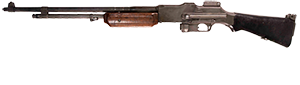
Browning Automatic Rifle
In service: 1918-limited utilise in Vietnam
Quotient: .30-06
Chapters: twenty rounds

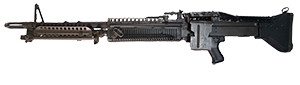
M-sixty
In service: 1960-however in limited use
Caliber: 7.62mm
Capacity: belt fed

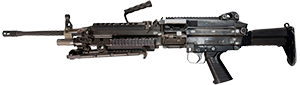
M-249
In service: 1984-nowadays
Caliber: five.56mm
Capacity: belt fed

Weight comparison in pounds
Range comparison in meters
The move to the 5.56x45mm NATO cartridge also influenced the reintroduction of a purpose-built SAW. In an effort to increase rifle firepower, amend armament compatibility Army-wide, and provide a lighter automatic weapon for the squad, the Army adopted the M249 in 1984. Although its high rate of fire and lighter weight accept served well, it needed to exist modernized based on age and clothing from decades of service. Furthermore, the M249's size is not well-suited to room clearing in dense urban combat environments.
seven Jason D. Bohannon, interview by Dr. Troy J. Sacquety, fourteen June 2019, USASOC History Office Classified Files, Fort Bragg, NC.
Concerns about the lethality of the 5.56x45mm NATO cartridge confronting combat troops wearing trunk armor were voiced. Co-ordinate to Major Thomas P. Ehrhart, "the U.S. infantry weapon has devolved from the World War I rifle capable of conducting lethal fire out to i,200 yards, to the current weapon that can hit a target out to 300 meters, but probably will non impale it [because of modernistic body armor] . . . the current U.S. infantrymen [is] less equipped to kill his enemy than his World War I predecessor." Because of changes on the battlefield, the Army began research on replacing the 5.56x45mm NATO cartridge with one of greater lethality.
eight Thomas P. Ehrhart, "Increasing Small Arms Lethality in Afghanistan: Taking Back the Infantry Half-Kilometer," (Fort Leavenworth, Kansas: School of Advanced Military Studies; U.S. Army Command and General Staff College, 2009), 24, on internet at https://apps.dtic.mil/dtic/tr/fulltext/u2/a512331.pdf , accessed 27 June 2019.
nine Todd Southward, "New rifle, bigger bullets: Within the Army'due south program to ditch the M4 and 5.56," Army Times, vii May 2017, on cyberspace at https://world wide web.armytimes.com/news/your-ground forces/2017/05/07/new-rifle-bigger-bullets-within-the-ground forces-s-programme-to-ditch-the-m4-and-5-56/ , accessed 12 June 2019.
To speed up the standard procurement process, U.South. Special Operations Command in 2016 investigated the commercial 6.5mm Creedmore cartridge every bit the basis for a more precise weapons arrangement. While heavier than the 5.56, it had more lethality and accuracy than the seven.62x51mm NATO cartridge, today's standard for sniper rifles. The 2017 operational tests showed that with rifles modified to fire 6.5mm Creedmore, soldiers "were twice as likely to hit their targets" compared to weapons with the vii.62x51mm NATO cartridge.
10 Joseph Trevithick, "U.S. Special Operators Will Shortly Exist Using This 6.5mm "Assault" Machine Gun," The Drive, 21 May 2019, on internet at https://www.thedrive.com/the-state of war-zone/28138/u-s-special-operators-will-shortly-exist-using-this-6-5mm-assault-automobile-gun , accessed 13 June 2018.
xi Joseph Trevithick, "Special Operators Getting A New Round For Their Precision Rifles And An 'Attack' Machine Gun," The Drive, x May 2018, on net at https://world wide web.thedrive.com/the-war-zone/20770/special-operators-getting-a-new-round-for-their-precision-rifles-and-an-set on-machine-gun , accessed 13 June 2018.
That said, the Army is looking to replace the M4A1 and M249 with two new weapons and a government designed 6.8mm cartridge that "falls in the sweet spot . . . with all the good characteristics of the heavier seven.62mm but with more than lethality and accuracy," and weighing less. The new weapon 'contenders' must improve the rifle squad capabilities against emerging threats, co-ordinate to Lieutenant Colonel Jason D. Bohannon, the Project Director for the new weapons system. The internally developed vi.8mm cartridge, and the weapons built to burn down it, will incorporate the latest technology, reduce bullet aerodynamic drag, and exist more lethal. The improvements "should final for the adjacent xxx years." Because the firing machinery will need to be more than robust, the new rifle volition be heavier than the current M4A1, merely because of incorporation of new construction materials, the SAW will be lighter than the M249.
12 Todd South, "Army's Adjacent Squad Weapon Will Burn a Never-Before-Seen Ammo Combination," Ground forces Times, 7 May 2018, on internet at https://www.armytimes.com/news/your-army/2018/05/08/armys-next-squad-weapon-volition-burn down-a-never-before-seen-ammo-combination/ , accessed xiii June 2019.
thirteen Bohannon interview.
Thanks to the Joint Armament Facility for making these weapons available for photographing.
TAKEAWAYS
- The bullet has always determined weapons blueprint.
- The Army has consistently adopted more accurate, longer range, and lighter weapons. Yet, to bargain with improved torso armor, a new generation rifle will be heavier than the M-16/M4A1 while the M249 replacement will be lighter.
- Historically, the Army has benefitted from using squad level weapons systems that used the same ammunition.

What Was The Service Rifle In Korean War,
Source: https://arsof-history.org/articles/19_aug_form_follows_function_page_1.html
Posted by: spiegelassight.blogspot.com
0 Response to "What Was The Service Rifle In Korean War"
Post a Comment